What Is Bacteriostatic Water? Composition, Benzyl Alcohol and Laboratory Use
Bacteriostatic water explained: 0.9% benzyl alcohol chemistry, how the preservative works, its limits, in-use handling and how it interacts with peptides.
By the APL Research Team · Updated · First published · 6 min read
Bacteriostatic water is sterile water containing 0.9% w/v benzyl alcohol, a preservative that limits microbial growth in a container that will be entered more than once. It is not a sterilant, and the benzyl alcohol is a chemically and biologically active solute rather than an inert additive. This page covers the composition, how the preservative works and where its protection ends, how a multi-entry vial should be handled in the laboratory, and how benzyl alcohol interacts with peptides and proteins.
Composition
| Component | Specification | Notes |
|---|---|---|
| Water | Sterile, pharmacopoeial grade | The bulk of the solution |
| Benzyl alcohol | 0.9% w/v = 9 mg/mL | About 83 mM |
| Benzyl alcohol identity | C₇H₈O, 108.14 g/mol, CAS 100-51-6 | Also called phenylmethanol (PubChem CID 244) |
| Container | Sealed multi-entry vial with septum | Designed for repeated withdrawal |
The molar figure follows from the mass: 9 g/L ÷ 108.14 g/mol = 0.083 mol/L. Benzyl alcohol is an aromatic alcohol, so it absorbs ultraviolet light and is moderately lipophilic, two properties that matter later. Sterile water is the same water without the preservative; the bacteriostatic water glossary entry gives the short definition.
How it differs from similar solutions
Several sterile aqueous solutions look alike on a shelf, and the differences decide which belongs in a given experiment.
| Solution | Preservative | Tonicity | Typical laboratory role |
|---|---|---|---|
| Sterile water | None | Hypotonic | Single-use diluent; stocks that will be aliquoted and frozen |
| Bacteriostatic water | 0.9% benzyl alcohol | Hypotonic | Multi-entry diluent for refrigerated peptide stocks |
| Bacteriostatic sodium chloride | Benzyl alcohol in 0.9% saline | Near-isotonic | Seldom used for peptides; added salt can lower the solubility of some sequences |
| Cell-culture grade water | None | Hypotonic | Preparing media and buffers; endotoxin-tested grades exist |
Tonicity rarely matters for a stock, because a few microlitres of a water-based stock barely change the osmolality of a millilitre of medium. It starts to matter when a stock makes up a large fraction of the final volume, which is one more reason to keep stocks concentrated.
Why products carry a preservative
Any container that is entered repeatedly risks introducing organisms with each entry. Formulators of multi-dose peptide and protein products address this with an antimicrobial preservative, and a review of licensed parenteral products found phenol and benzyl alcohol to be the two most common preservatives in peptide and protein products [1]. The same review lists the selection criteria: the preservative concentration, its antimicrobial performance and its effect on the active ingredient [1].
That last criterion is not a formality. A 2023 overview of preservatives in biologics notes that some preservatives increase protein and peptide particle formation, so compatibility with the molecule has to be established alongside the preservative function [2].
How benzyl alcohol works
Benzyl alcohol acts on cell membranes. In a comparison of phenolic compounds and aromatic alcohols, all of the compounds tested had lethal effects and altered bacterial membranes, especially in Gram-negative species, with activity related to lipophilicity; for benzyl alcohol and phenethyl alcohol, killing stopped when bacterial protein synthesis was blocked, pointing to additional, more specific mechanisms [3]. In mammalian cell biology the same compound is used as a membrane fluidiser [4].
How fast it works is not fixed. A kinetic study of benzyl alcohol against Aspergillus niger, Candida albicans, Escherichia coli, Pseudomonas aeruginosa and Staphylococcus aureus found its efficacy depended on the solution's pH, temperature and preservative concentration [5]. "Bacteriostatic" describes the intended effect at 0.9%: organisms introduced on entry are prevented from multiplying and are reduced over time, not destroyed instantly.
Preserved multi-entry products are judged by an antimicrobial effectiveness test, in which the product is challenged with defined organisms and their numbers are followed over time; the pharmacopoeias have harmonised how the test is run but not its acceptance criteria [6].
What the preservative does not do
- It does not sterilise a contaminated solution quickly. A large inoculum, such as from a non-sterile needle or a splash, can outlast it.
- It does not remove endotoxin. When multi-dose medications were deliberately contaminated, endotoxin was detected in both products tested for it [7]. Killed bacteria still leave their cell-wall material behind; see endotoxin.
- It does not deal with particles or chemical contaminants. Fibres, coring fragments from a damaged septum and residues are unaffected.
- Its effect depends on the formulation. In the same contamination study, some multi-dose medications killed all inoculated organisms within 24 hours, others allowed limited survival, and one supported growth of several strains under some conditions [7].
The preservative is a margin for small, occasional lapses. It does not replace sterile technique.
Benzyl alcohol and peptides
Benzyl alcohol can destabilise folded proteins. At 0.9% w/v it altered the near-UV circular dichroism spectrum of recombinant interferon-gamma and produced high-molecular-weight aggregates, faster at lower protein concentration and at higher buffer or preservative concentration [8]. With interleukin-1 receptor antagonist, weak hydrophobic binding of benzyl alcohol favoured partially unfolded, aggregation-competent molecules during incubation at 37 °C, and sucrose partly suppressed the effect [9].
Peptides need not behave the same way. In NMR work on an acylated 31-residue peptide, benzyl alcohol neither induced aggregation nor showed detectable interaction with the peptide, whereas 1% m-cresol produced insoluble peptide aggregates within 24 hours at room temperature [10]. The direction of the effect is therefore molecule-specific. Published data for short research peptides are sparse, so a stability check by HPLC is worthwhile before committing a scarce or aggregation-prone peptide to a benzyl alcohol stock.
Benzyl alcohol is not inert to cells
The membrane activity that makes benzyl alcohol a preservative also affects mammalian cells. At membrane-fluidising concentrations it reversibly fragmented the Golgi apparatus and inhibited endosome-to-Golgi transport in cultured cells, and clinically it has been linked to hypersensitivity reactions and neonatal deaths [4]. In human retinal pigment epithelial cells, 0.225 mg/mL impaired function within two hours, while 0.0225 mg/mL did not [11]. How these concentrations compare with what a diluted stock delivers to a culture well, and how to design the vehicle control, is worked through in bacteriostatic water vs sterile water.
Benzyl alcohol degrades in solution
Benzyl alcohol oxidises slowly in water to benzaldehyde and then benzoic acid. In aqueous solutions stored over long periods, the amounts of both products depended on the starting benzyl alcohol concentration, the storage time and the storage conditions [12]. This is a reason to respect the expiry date, keep vials closed and stored as labelled, and avoid decanting the diluent into secondary containers that sit open.
What each property means at the bench
| Property | Practical consequence |
|---|---|
| Antimicrobial preservative | Suits a refrigerated stock drawn from repeatedly over days |
| Membrane-active solute at 83 mM | Must appear in the vehicle control of any cell-based assay |
| Aromatic, UV-absorbing compound | Can appear as an extra peak in HPLC-UV runs of a peptide stock |
| Interacts with some folded proteins | Check compatibility for proteins and aggregation-prone peptides |
| Oxidises slowly to benzaldehyde | Respect expiry; store closed and as labelled |
| Preservative unnecessary once frozen in single-use aliquots | Sterile water is simpler for stocks destined for the freezer |
Handling a multi-entry vial
- Check the label for composition, lot and expiry, and inspect the liquid: clear, colourless and free of particles, with an intact seal.
- Write the date of first puncture on the vial.
- Wipe the septum with 70% alcohol and let it dry before every entry.
- Use a new sterile needle and syringe, or a sterile pipette in a clean cabinet, for each withdrawal; never return liquid to the vial.
- Store the vial as labelled and discard it at the end of its in-use period, or earlier if it becomes cloudy or the septum is damaged.
The peptide reconstitution guide covers how the diluent goes into a peptide vial, and the peptide storage guide covers how long the resulting solution should be kept.
Our bacteriostatic water
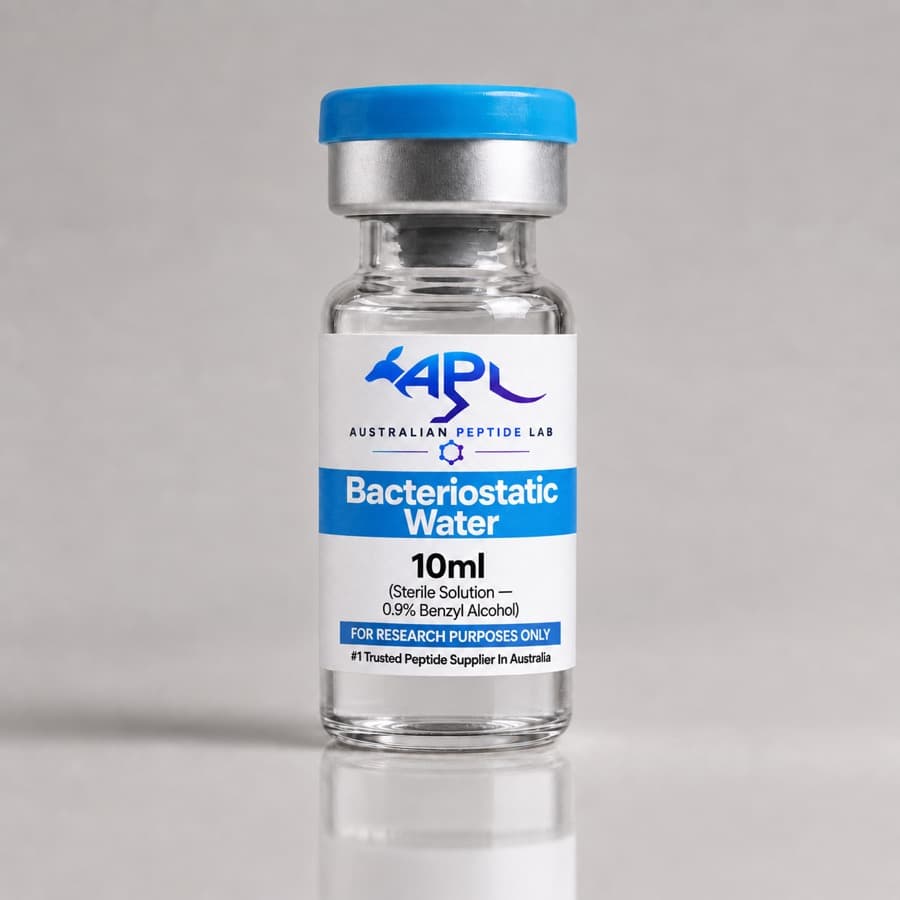
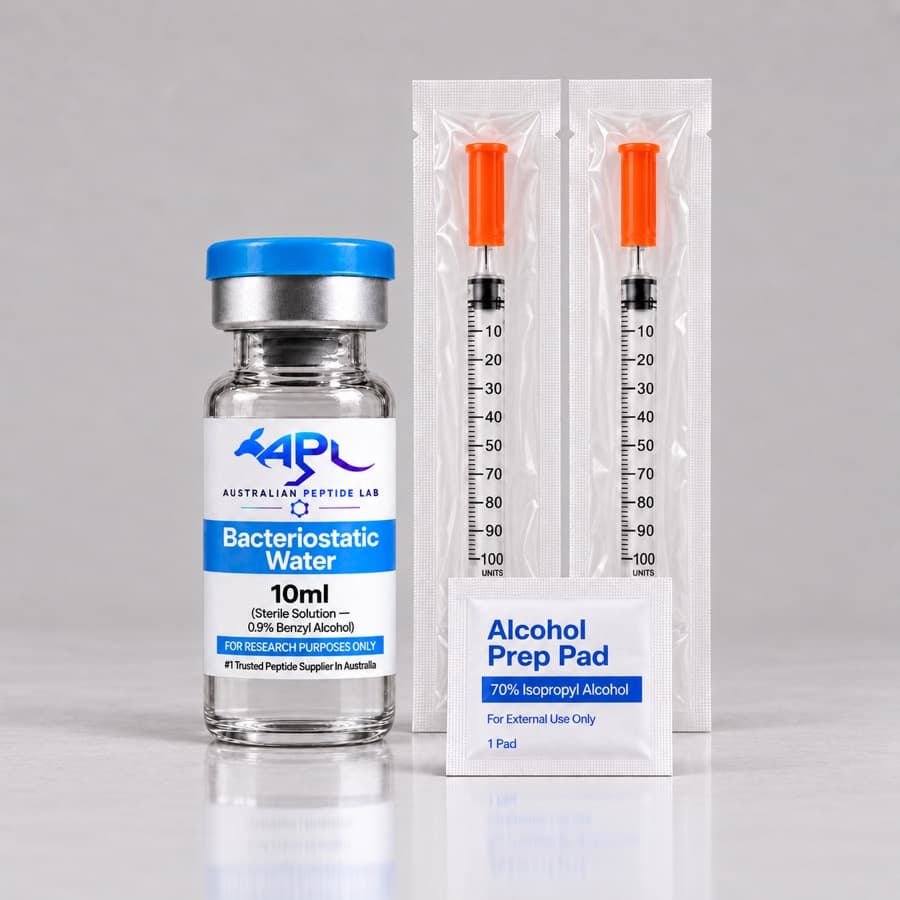
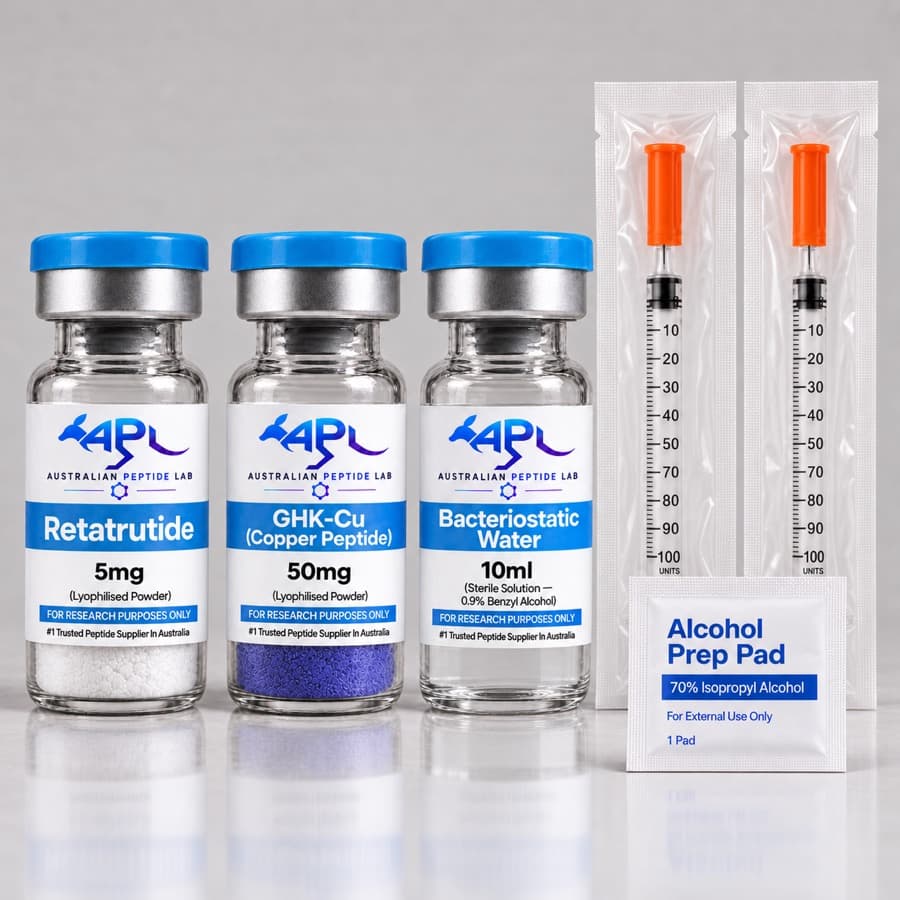
Our bacteriostatic water is USP-grade sterile water with 0.9% benzyl alcohol in a sealed vial, supplied as a single 10 mL vial or a pack of three 10 mL vials. It is stored at room temperature and labelled for discard 28 days after first puncture. The Research Starter Kit pairs a 10 mL vial with ten sterile 1 mL syringes and twenty alcohol swabs, and the Complete Research Bundle includes that kit. Other consumables are in lab supplies.
Frequently asked questions
Is bacteriostatic water the same as sterile water?
No. Both are sterile when sealed, but bacteriostatic water also contains 0.9% w/v benzyl alcohol, a preservative that suppresses the growth of organisms introduced when the container is entered. Sterile water has no preservative and is meant for single use. The benzyl alcohol is the whole difference, and it matters for cell-based work; see bacteriostatic water vs sterile water.
What is 0.9% benzyl alcohol in molar terms?
0.9% w/v is 9 mg of benzyl alcohol per mL. With a molecular weight of 108.14 g/mol, that is about 83 mM, a substantial solute concentration. A peptide stock made in bacteriostatic water and diluted 1:100 into assay medium carries about 0.83 mM benzyl alcohol into the well, which is why the vehicle control needs the same dilution of the same diluent.
Does bacteriostatic water kill bacteria?
It suppresses growth and kills slowly rather than sterilising on contact. Benzyl alcohol and related aromatic alcohols alter bacterial membranes and do have lethal effects [3], but the rate depends on concentration, pH and temperature [5]. A heavily contaminated vial is not rescued by the preservative, and dead organisms can still leave endotoxin behind [7].
Why is bacteriostatic water discarded 28 days after first use?
Our bacteriostatic water is labelled for discard 28 days after the first puncture. An in-use limit caps the number of entries and the time over which contamination can accumulate in a preserved, multi-entry container. Treat it as a maximum: discard sooner if the liquid becomes cloudy, the septum is damaged or the vial was entered without aseptic technique.
Does benzyl alcohol damage peptides?
It depends on the molecule. Benzyl alcohol at 0.9% induced aggregation of folded proteins such as interferon-gamma [8] and interleukin-1 receptor antagonist [9], through partial unfolding. In an acylated 31-residue peptide, however, it caused no aggregation or detectable interaction, whereas m-cresol did [10]. Data for short research peptides are sparse, so compatibility is worth checking for valuable or aggregation-prone sequences.
References
- 1.Meyer BK, Ni A, Hu B, et al. Antimicrobial preservative use in parenteral products: past and present. J Pharm Sci. 2007. PubMed 17722087
- 2.Stroppel L, Schultz-Fademrecht T, Cebulla M, et al. Antimicrobial Preservatives for Protein and Peptide Formulations: An Overview. Pharmaceutics. 2023. PubMed 36839885
- 3.Lucchini JJ, Corre J, Cremieux A. Antibacterial activity of phenolic compounds and aromatic alcohols. Res Microbiol. 1990. PubMed 1697976
- 4.Simm R, Kvalvaag AS, van Deurs B, et al. Benzyl alcohol induces a reversible fragmentation of the Golgi apparatus and inhibits membrane trafficking between endosomes and the trans-Golgi network. Exp Cell Res. 2017. PubMed 28450044
- 5.Karabit MS, Juneskans OT, Lundgren P. Studies on the evaluation of preservative efficacy--II. The determination of antimicrobial characteristics of benzylalcohol. J Clin Hosp Pharm. 1986. PubMed 3531242
- 6.Moser CL, Meyer BK. Comparison of compendial antimicrobial effectiveness tests: a review. AAPS PharmSciTech. 2011. PubMed 21221871
- 7.Highsmith AK, Greenhood GP, Allen JR. Growth of nosocomial pathogens in multiple-dose parenteral medication vials. J Clin Microbiol. 1982. PubMed 7050144
- 8.Lam XM, Patapoff TW, Nguyen TH. The effect of benzyl alcohol on recombinant human interferon-gamma. Pharm Res. 1997. PubMed 9210188
- 9.Zhang Y, Roy S, Jones LS, et al. Mechanism for benzyl alcohol-induced aggregation of recombinant human interleukin-1 receptor antagonist in aqueous solution. J Pharm Sci. 2004. PubMed 15514986
- 10.Li M, Falk BT, Lu X, et al. Molecular Mechanism of Antimicrobial Excipient-Induced Aggregation in Parenteral Formulations of Peptide Therapeutics. Mol Pharm. 2022. PubMed 35917158
- 11.Chang YS, Wu CL, Tseng SH, et al. In vitro benzyl alcohol cytotoxicity: implications for intravitreal use of triamcinolone acetonide. Exp Eye Res. 2008. PubMed 18420195
- 12.Sudareva NN, Chubarova EV. Time-dependent conversion of benzyl alcohol to benzaldehyde and benzoic acid in aqueous solutions. J Pharm Biomed Anal. 2006. PubMed 16564153
This article summarises published research for educational purposes. It is not medical advice. Compounds sold by Australian Peptide Lab are research reagents for in-vitro laboratory use only, not for human or veterinary use.