
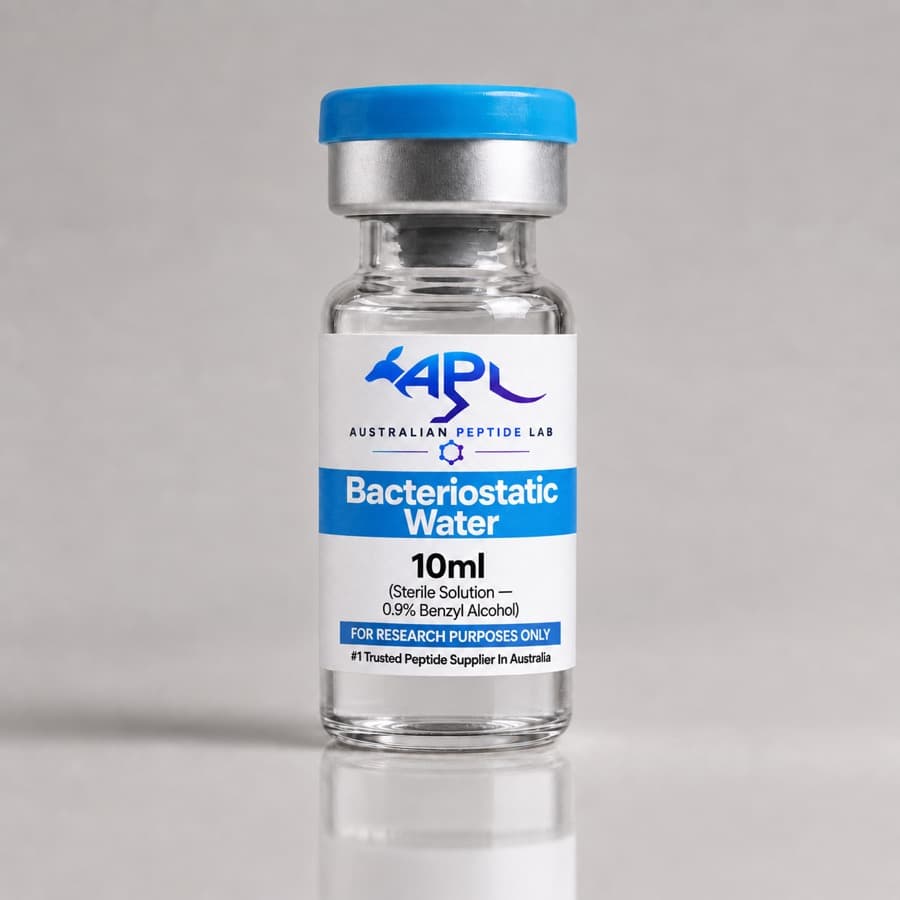
Bacteriostatic Water
Bacteriostatic water is sterile water containing 0.9% benzyl alcohol, a preservative that suppresses the growth of microbes introduced when a vial is punctured more than once. It is the usual diluent when a diluent vial or a reconstituted stock will be sampled several times. Benzyl alcohol is not biologically inert, so cell-based experiments need it in the vehicle control or a preservative-free diluent instead.
Total
$8.00 AUD
Out of stock — fresh batches are being tested now.
- 🚚 Order before 12pm AEST for same-day dispatch · express 1–3 business days
- 📦 Free shipping over $250 (otherwise $14.95) · plain, unbranded packaging
- 🛡️ 14-day replacement or refund if damaged, defective or incorrect
All products sold by Australian Peptide Lab are strictly for in-vitro laboratory research purposes only. Not for human or veterinary use, consumption, or any form of in-vivo application.
What bacteriostatic water is
Bacteriostatic water is sterile water with an antimicrobial preservative added so that one vial can be punctured more than once. The US Pharmacopeia monograph, as described by an Amgen analytical group, defines it as sterile water containing one or more suitable antimicrobial agents, with a pH between 4.5 and 7.0; it has no buffering capacity and very low ionic strength [1]. The preservative is almost always benzyl alcohol, which with phenol is one of the two antimicrobial preservatives most often used in licensed peptide and protein products [2].
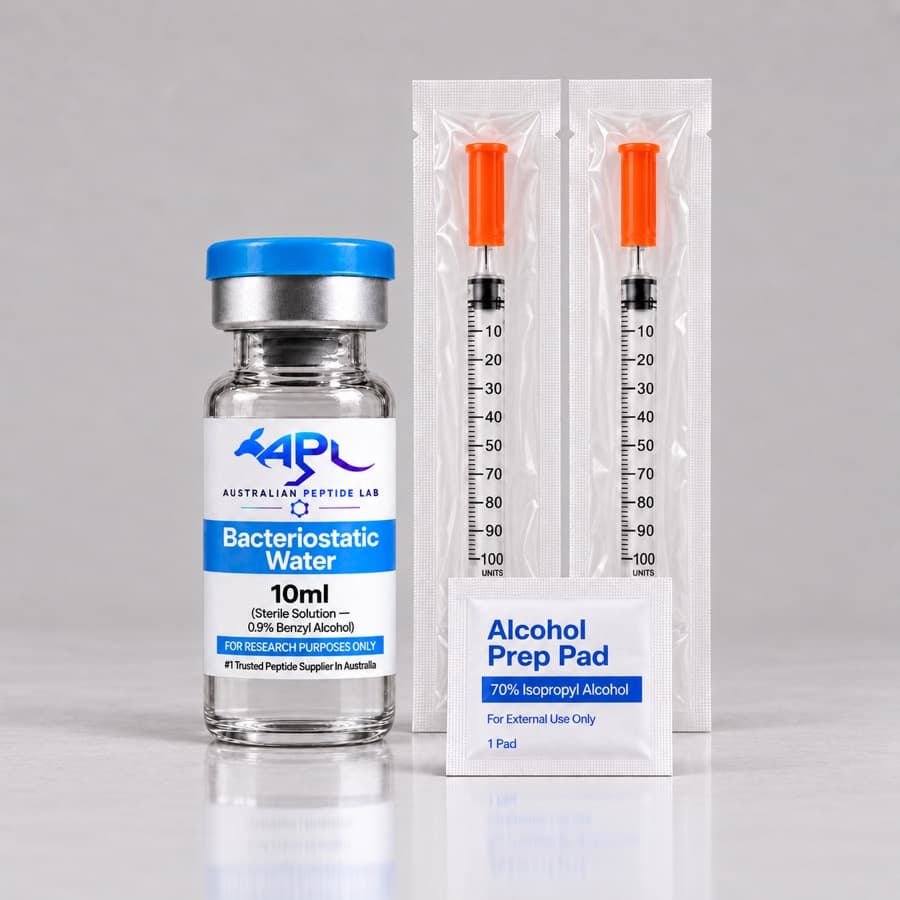
This product contains 0.9% w/v benzyl alcohol and comes in 10 mL vials, singly or as a pack of three. It is the diluent in the Research Starter Kit and is used to reconstitute the lyophilised compounds in the shop.
| Component | Concentration | Notes |
|---|---|---|
| Sterile water | Solvent | Unbuffered, low ionic strength [1] |
| Benzyl alcohol (C7H8O) | 9 mg/mL (0.9% w/v), about 83 mM | 108.14 g/mol; CAS 100-51-6; PubChem CID 244 |
| Sodium chloride | None | Bacteriostatic saline (0.9% NaCl) is a separate product |
| Buffer | None | A peptide solution's pH is set largely by the peptide and its counter-ions |
What "bacteriostatic" means
Bacteriostatic describes an agent that stops microbes multiplying, not one that reliably sterilises. Aromatic alcohols such as benzyl alcohol damage bacterial membranes, an activity tied to their lipophilicity, and can kill at high enough concentration [3]. Their effect is concentration-dependent: when epoetin alfa was diluted with benzyl alcohol-preserved saline, both batches at 0.54% benzyl alcohol met USP preservative-effectiveness criteria, but one batch at 0.45% did not [4].
Two consequences follow for peptide work:
- Reconstitution barely dilutes the preservative. A few milligrams of peptide in 1–2 mL leaves benzyl alcohol close to 0.9%. Diluting that stock further into unpreserved buffer or medium removes the preservative effect along with the concentration.
- Preservation is not instant. When multiple-dose medications were deliberately inoculated, some organisms were gone within 4 hours while others persisted for up to 7 days, and every product held organisms longer at 4 °C than at 22 °C [5]. A refrigerated stock does not clean itself; technique matters more than the preservative.
The 28-day in-use convention
The storage instruction for this product is to discard the vial 28 days after first puncture. The figure comes from US Pharmacopeia General Chapter <797>: as summarised in US CDC injection-safety guidance, an opened or needle-punctured multiple-dose vial is dated and discarded within 28 days unless the manufacturer specifies otherwise, and never after its original expiry date. It is a ceiling for an opened container, not a measurement of how long benzyl alcohol stays effective.
In-use data suggest handling matters more than the calendar:
| Study | Setting | Finding |
|---|---|---|
| Simonek et al., 2017 | Laboratory-animal facility; carprofen diluted in unpreserved sterile water, stoppers not swabbed, new needle each time, punctured twice daily | No bacterial growth or endotoxin over 28 days [6] |
| Mattner and Gastmeier, 2004 | 1,300-bed German hospital, 227 in-use vials | 0.9% contaminated; only half dated on opening, and 13% of those already past their date [7] |
| Motamedifar and Askarian, 2009 | Iranian teaching hospital, 637 in-use vials | 5.6% contaminated, mostly skin commensals such as Staphylococcus epidermidis [8] |
For a laboratory that means dating the vial at first puncture, using a fresh sterile needle for every entry and treating 28 days as an upper limit. The peptide's own stability in solution sets a separate limit, covered in the peptide storage guide.
Benzyl alcohol in cell-based and protein work
Benzyl alcohol is a membrane-active small molecule, and at the concentrations reached when a bacteriostatic stock is diluted into culture medium it can have measurable effects of its own.
| Stock diluted into medium | Benzyl alcohol (mg/mL) | Benzyl alcohol (mM) |
|---|---|---|
| Undiluted bacteriostatic water | 9.0 | 83 |
| 1:10 | 0.90 | 8.3 |
| 1:100 | 0.090 | 0.83 |
| 1:1,000 | 0.0090 | 0.083 |
Set against the published work:
- Cytotoxicity. In human retinal pigment epithelial (ARPE-19) cells, 0.225 mg/mL caused ultrastructural damage and impaired function within 2 hours while 0.0225 mg/mL did not, and 9 mg/mL, the undiluted preservative level, was toxic within 5 minutes [9]. Cell death involved necrosis plus caspase-dependent and caspase-independent apoptosis [10].
- Signalling below toxic levels. In MDCK renal epithelial cells, 10 mM benzyl alcohol fluidised membranes, doubled basal cAMP and altered cAMP responses to glucagon, prostaglandin E2 and forskolin [11]. That matters for assays read out by cAMP, including those for the GLP-1, GIP, glucagon, GHRH and melanocortin receptors targeted by many research peptides. In K562 cells, benzyl alcohol-induced membrane fluidisation was enough to switch on heat shock protein expression at normal culture temperature [12].
- Tissue models. Topical benzyl alcohol at 0.075–0.3% accelerated functional recovery of injured Achilles tendons in rats compared with saline, with more collagen and capillaries on histology [13]. In repair models of the kind used for BPC-157, it cannot be treated as an inert vehicle.
Most of these exposures lasted minutes to hours; multi-day incubations were not tested, so the concentrations above are not safe limits. The working rule is a vehicle control carrying the same final benzyl alcohol concentration as the treated wells, or stocks for cell work made in sterile water, with bacteriostatic water kept for stocks that will be sampled repeatedly.
Effects on the dissolved peptide
Benzyl alcohol can also act on the solute. Lyophilised recombinant interleukin-1 receptor antagonist aggregated more when reconstituted with 0.9% benzyl alcohol than with water, and the extent tracked how much native structure had survived freeze-drying; storage after reconstitution did not accelerate aggregation further [14]. In contrast, solution NMR of an acylated 31-residue peptide found no benzyl alcohol-induced aggregation or detectable interaction, while 1% m-cresol drove the same peptide into insoluble aggregates [15]. Because the effect is molecule-specific, the useful check for a long-held stock is an HPLC run at the start and end of storage, looking for new peaks or loss of the main one; see peptide aggregation.
Bacteriostatic water vs sterile water
| Bacteriostatic water | Sterile water | |
|---|---|---|
| Preservative | Benzyl alcohol 0.9% | None |
| Repeated withdrawals | Intended, within 28 days of first puncture | Treat as single-use once opened; infection-control guidance discourages multiple use of unpreserved products [7] |
| Buffer or salt | None | None |
| As a cell-assay vehicle | Needs a benzyl alcohol-matched control | Simplest vehicle |
| Typical role | Stocks sampled several times at 2–8 °C | Stocks for cell work; aliquot-and-freeze workflows |
Bacteriostatic water vs sterile water works through which suits a given experiment, and what is bacteriostatic water covers the background.
Handling, volumes and storage
Store unopened vials at room temperature. Before each puncture, swab the septum with alcohol and let it dry; the Research Starter Kit page summarises the evidence on swabbing technique. Discard the vial 28 days after first puncture, or sooner if the liquid turns cloudy or particles appear.
| Reconstitution | Diluent | Resulting concentration | Per 10 mL vial |
|---|---|---|---|
| 5 mg peptide | 2.0 mL | 2.5 mg/mL | 5 reconstitutions |
| 10 mg peptide | 2.0 mL | 5.0 mg/mL | 5 reconstitutions |
| 10 mg peptide | 1.0 mL | 10 mg/mL | 10 reconstitutions |
| 50 mg peptide | 5.0 mL | 10 mg/mL | 2 reconstitutions |
The reconstitution calculator handles other combinations, the dilution calculator works out the benzyl alcohol carried into a working solution, and the peptide reconstitution guide covers technique. Reconstituted stocks that will not be used within days are better split into single-use aliquots and frozen than punctured repeatedly.
Bacteriostatic Water: frequently asked questions
What exactly is in bacteriostatic water?
Sterile water and benzyl alcohol at 0.9% w/v, which is 9 mg per mL or about 83 mM. The pharmacopoeial definition is sterile water containing a suitable antimicrobial agent, with a pH range of 4.5–7.0 and no buffer [1]. It contains no sodium chloride; bacteriostatic saline, which adds 0.9% NaCl (about 154 mM), is a different product. The benzyl alcohol is PubChem CID 244, CAS 100-51-6.
Why is the in-use limit 28 days?
Twenty-eight days is the default discard period for opened multiple-dose vials under US Pharmacopeia General Chapter <797>, as summarised in US CDC injection-safety guidance, unless the manufacturer states otherwise and never beyond the original expiry date. It is a convention rather than a measured limit for benzyl alcohol; in-use studies point to handling as the bigger variable [6, 7]. Write the date of first puncture on the label.
Can bacteriostatic water be used to make stocks for cell culture?
It can, but the benzyl alcohol travels with the peptide. Diluted 1:100 into medium it is still 0.09 mg/mL (0.83 mM), between the 0.0225 mg/mL that left human retinal pigment epithelial cells unaffected over 2 hours and the 0.225 mg/mL that impaired them [9]. Match benzyl alcohol in the vehicle control, or reconstitute in sterile water; see bacteriostatic vs sterile water.
Does benzyl alcohol damage peptides?
It depends on the molecule. Reconstituting a lyophilised protein, recombinant IL-1 receptor antagonist, with 0.9% benzyl alcohol caused more aggregation than water [14], whereas NMR showed no benzyl alcohol-induced aggregation of an acylated 31-residue peptide that m-cresol did aggregate [15]. Where a stock will be held for weeks, compare HPLC traces at the start and end of storage.
How many reconstitutions does a 10 mL vial cover?
At 2.0 mL per peptide vial, one 10 mL vial covers five reconstitutions; at 1.0 mL, ten. The 28-day clock starts at first puncture, so the 3 × 10 mL pack lets each vial stay sealed until it is needed. The reconstitution calculator gives the diluent volume for a target concentration.
Is bacteriostatic water still sterile once opened?
That cannot be assumed. The preservative suppresses growth but does not act instantly: in inoculation studies of preserved multiple-dose medications, some bacteria persisted for up to 7 days, and for longer at 4 °C than at room temperature [5]. Hospital surveys have found contamination in 0.9–5.6% of in-use multiple-dose vials [7, 8]. The sterile technique guide covers the handling that does most of the work.
How is this product specified and documented?
It is sterile water with 0.9% benzyl alcohol in a sealed 10 mL vial, sold singly or as a 3 × 10 mL pack, stored at room temperature and discarded 28 days after first puncture. Batch documentation is available on request. Laboratories checking pH should expect slow, noisy readings: unbuffered, low-ionic-strength water is hard to measure, which is why the pharmacopoeial method adds KCl [1].
References
- 1.Hu J, Kyad A, Burke K, et al. Critical Aspects of pH Measurement for Bacteriostatic Water for Injection. J Pharm Sci. 2023. PubMed 36870668
- 2.Meyer BK, Ni A, Hu B, et al. Antimicrobial preservative use in parenteral products: past and present. J Pharm Sci. 2007. PubMed 17722087
- 3.Lucchini JJ, Corre J, Cremieux A. Antibacterial activity of phenolic compounds and aromatic alcohols. Res Microbiol. 1990. PubMed 1697976
- 4.Corbo DC, Suddith RL, Sharma B, et al. Stability, potency, and preservative effectiveness of epoetin alfa after addition of a bacteriostatic diluent. Am J Hosp Pharm. 1992. PubMed 1529989
- 5.Longfield RN, Smith LP, Longfield JN, et al. Multiple-dose vials: persistence of bacterial contaminants and infection control implications. Infect Control. 1985. PubMed 3846586
- 6.Simonek GD, Alarcio GG, Brignolo LL. Sterility and Stability of Diluted Carprofen in a Multidose Vial in the Laboratory Animal Setting. J Am Assoc Lab Anim Sci. 2017. PubMed 28535864
- 7.Mattner F, Gastmeier P. Bacterial contamination of multiple-dose vials: a prevalence study. Am J Infect Control. 2004. PubMed 14755229
- 8.Motamedifar M, Askarian M. The prevalence of multidose vial contamination by aerobic bacteria in a major teaching hospital, Shiraz, Iran, 2006. Am J Infect Control. 2009. PubMed 19362388
- 9.Chang YS, Wu CL, Tseng SH, et al. In vitro benzyl alcohol cytotoxicity: implications for intravitreal use of triamcinolone acetonide. Exp Eye Res. 2008. PubMed 18420195
- 10.Chang YS, Lin CF, Wu CL, et al. Mechanisms underlying benzyl alcohol cytotoxicity (triamcinolone acetonide preservative) in human retinal pigment epithelial cells. Invest Ophthalmol Vis Sci. 2011. PubMed 21345998
- 11.Friedlander G, Le Grimellec C, Giocondi MC, et al. Benzyl alcohol increases membrane fluidity and modulates cyclic AMP synthesis in intact renal epithelial cells. Biochim Biophys Acta. 1987. PubMed 2820491
- 12.Balogh G, Horváth I, Nagy E, et al. The hyperfluidization of mammalian cell membranes acts as a signal to initiate the heat shock protein response. FEBS J. 2005. PubMed 16302971
- 13.You T, Yuan S, Bai L, et al. Benzyl alcohol accelerates recovery from Achilles tendon injury, potentially via TGF-β1/Smad2/3 pathway. Injury. 2020. PubMed 32409188
- 14.Roy S, Jung R, Kerwin BA, et al. Effects of benzyl alcohol on aggregation of recombinant human interleukin-1-receptor antagonist in reconstituted lyophilized formulations. J Pharm Sci. 2005. PubMed 15614819
- 15.Li M, Falk BT, Lu X, et al. Molecular Mechanism of Antimicrobial Excipient-Induced Aggregation in Parenteral Formulations of Peptide Therapeutics. Mol Pharm. 2022. PubMed 35917158
Related Research Compounds
Read more about Bacteriostatic Water
What Is Bacteriostatic Water? Composition, Benzyl Alcohol and Laboratory Use
Bacteriostatic water explained: 0.9% benzyl alcohol chemistry, how the preservative works, its limits, in-use handling and how it interacts with peptides.
6 min read →Lab TechniqueBacteriostatic Water vs Sterile Water: Choosing a Diluent for In-Vitro Peptide Work
Bacteriostatic vs sterile water for peptide stocks: a comparison table, benzyl alcohol levels carried into assays, vehicle controls and when each fits.
6 min read →Lab TechniquePeptide Reconstitution: A Bench Method for Lyophilised Research Peptides
A bench method for reconstituting lyophilised peptides: equilibration, diluent choice, adding diluent, concentration tables, aliquoting and labelling.
8 min read →