Bacteriostatic Water vs Sterile Water: Choosing a Diluent for In-Vitro Peptide Work
Bacteriostatic vs sterile water for peptide stocks: a comparison table, benzyl alcohol levels carried into assays, vehicle controls and when each fits.
By the APL Research Team · Updated · 6 min read
Bacteriostatic water and sterile water differ by one ingredient, 0.9% benzyl alcohol, and that ingredient decides which belongs in an experiment. Sterile water adds nothing to an assay but offers no protection once the container has been entered; bacteriostatic water protects a multi-entry stock but carries a membrane-active compound into every well it touches. This guide compares the two, quantifies how much benzyl alcohol reaches cells at common dilutions, and sets out how to build the vehicle control.
Side-by-side comparison
| Property | Sterile water | Bacteriostatic water |
|---|---|---|
| Composition | Water only | Water with 0.9% w/v benzyl alcohol (about 83 mM) |
| Sterile when sealed | Yes | Yes |
| Protection after entry | None | Preservative limits growth of introduced organisms |
| Container use | Single entry; discard the remainder | Repeated entry within a labelled in-use period (ours: 28 days) |
| What it adds to an assay | Nothing beyond water | Benzyl alcohol at the stock's dilution |
| Effect on folded proteins | None | Can promote aggregation of some proteins |
| HPLC-UV of a peptide stock | Clean baseline | An extra benzyl alcohol peak |
| Endotoxin | Depends on grade | Depends on grade |
| Best suited to | Frozen single-use aliquots, cell-based assays, analytical standards | Refrigerated stocks drawn from repeatedly for biochemical work |
The underlying chemistry of the preservative is covered in what is bacteriostatic water; this page is about the experimental consequences.
How much benzyl alcohol reaches the cells
Benzyl alcohol at 9 mg/mL (molecular weight 108.14 g/mol) is 83.2 mM. Whatever the peptide's dilution from stock to well, the benzyl alcohol is diluted by the same factor:
| Stock-to-well dilution | Final benzyl alcohol (mg/mL) | Final benzyl alcohol (molar) |
|---|---|---|
| 1:10 | 0.90 | 8.3 mM |
| 1:100 | 0.090 | 0.83 mM |
| 1:1,000 | 0.0090 | 83 µM |
| 1:10,000 | 0.00090 | 8.3 µM |
Published cell studies give reference points for these figures:
| Concentration | Molar equivalent | Reported effect | System |
|---|---|---|---|
| 9 mg/mL | 83 mM | Toxic within 5 minutes [1]; extensive apoptotic and necrotic death after 6 hours [2] | Human and rabbit retinal pigment epithelial (RPE) cells |
| — | 40 mM | Inhibited cAMP synthesis stimulated by prostaglandin E2, forskolin and vasopressin [3] | MDCK renal epithelial cells |
| — | 30 mM | Fluid-phase endocytosis inhibited by 83%, reversed within 30 minutes of washing [4] | MDCK cells |
| — | 10 mM | Enhanced cAMP responses to prostaglandin E2, glucagon and forskolin [3] | MDCK cells |
| 0.225 mg/mL | 2.1 mM | Ultrastructural damage and impaired function at 2 hours [1] | Human RPE cells |
| 0.0225 mg/mL | 0.21 mM | No damage detected at 2 hours [1] | Human RPE cells |
Read against each other, the tables give a rough guide. A 1:10 dilution lands in the range where benzyl alcohol alters membrane trafficking and signalling. A 1:100 dilution (0.83 mM) falls between the RPE no-effect and damaging concentrations. At 1:1,000 or beyond, the final concentration is below every effect level in these studies. The evidence base is thin, though: a few cell types, exposures of minutes to hours, and specific read-outs. Benzyl alcohol is a membrane fluidiser that also fragments the Golgi apparatus and slows endosome-to-Golgi transport [5], so assays of membrane trafficking, receptor internalisation or cAMP signalling deserve extra caution even at low concentrations, as do incubations lasting days.
Effects on the peptide itself
Benzyl alcohol can act on the solute as well as the cells. With interferon α-2a it induced aggregation in a concentration-dependent manner by populating a partially unfolded intermediate, lowering the apparent aggregation temperature as its concentration rose [6]. In an acylated 31-residue peptide, by contrast, it caused no aggregation and no detectable interaction [7]. The likely risk is highest for folded proteins and self-associating peptides and lowest for short, unstructured sequences, but the data are too sparse to assume either way for a particular research peptide. Comparing HPLC profiles of the same stock prepared in both diluents, at the start and end of its intended hold time, settles the question for a given molecule.
When the vehicle is not neutral
Benzyl alcohol has biological activity of its own in repair models. In rats with an experimental Achilles tendon wound, topical benzyl alcohol at 0.075–0.3% improved functional recovery compared with saline, with more collagen and capillaries, fewer inflammatory cells and increased TGF-β1 and Smad2/3 expression [8]. The lesson for anyone reading or designing tissue-repair studies, a field that includes much of the BPC-157 literature, is that a benzyl alcohol vehicle is not a neutral control and has to appear in its own arm.
Building the vehicle control
The same principle applies to any solvent, from DMSO to benzyl alcohol. Researchers reporting unexpected DMSO toxicity recommended computing absolute final solvent concentrations and including an untreated group as well as a vehicle group [9], and a CSIRO study of low-concentration DMSO effects on fish cells reached the same conclusion about solvent controls at matching concentrations [10].
A worked example with a bacteriostatic stock:
| Step | Value |
|---|---|
| Stock | BPC-157 at 2.5 mg/mL (1.76 mM) in bacteriostatic water |
| Target | 10 µM in 1.0 mL of medium |
| Dilution factor | 1,761 µM ÷ 10 µM = 176 |
| Stock volume | 1,000 µL ÷ 176 = 5.7 µL |
| Benzyl alcohol in the well | 83.2 mM ÷ 176 = 0.47 mM (0.051 mg/mL) |
| Vehicle control | 5.7 µL of the same bacteriostatic water lot in 1.0 mL of medium |
The trap is a concentration–response series. If each concentration is made by adding a different volume of stock, benzyl alcohol varies across the series and its effect becomes confounded with the peptide's. Hold the vehicle constant instead: make intermediate dilutions in the same diluent so every well receives the same stock volume, or top up lower concentrations with plain diluent. Designing dose–response experiments covers series design, and the dilution calculator handles the volumes.
What sterile water gives up
The case for bacteriostatic water is the case against entering an unpreserved container repeatedly. When multi-dose medications were deliberately contaminated with hospital organisms, the outcome depended entirely on the formulation: some killed every organism within 24 hours, others allowed slow die-off or limited survival, and one supported survival or growth of several strains under some conditions, with endotoxin detectable in contaminated products [11]. Plain water offers no antimicrobial activity at all, and a dissolved peptide adds a nutrient source.
The practical answer is not to choose bacteriostatic water by default but to remove the repeated entries. A peptide reconstituted in sterile water and divided at once into single-use aliquots is entered once, frozen, and thawed once, which removes the risk the preservative was designed for without putting benzyl alcohol into the assay. Bacteriostatic water earns its place when a refrigerated stock genuinely has to be sampled many times, as with a shared reference solution or a biochemical assay run daily over a week.
Sterile is not the same as endotoxin-free
Neither diluent's sterility says anything about endotoxin. A survey of reagents used in microglia research found significant lipopolysaccharide contamination in a number of commercial-grade proteins, phospholipids and synthetic peptide preparations, but not in pharmaceutical-grade recombinant proteins, and polymyxin B blocked part of the activity attributed to several of the factors tested [12]. For immune-cell and inflammation assays, specify water and reagents by endotoxin grade, and consider a polymyxin B control; sterile technique for peptide handling covers the wider routine.
When each fits
| Situation | Choose | Reason |
|---|---|---|
| Stock to be split into single-use aliquots and frozen | Sterile water | A preservative has no role once aliquots are frozen |
| Cell-based assay, especially primary cells or multi-day incubations | Sterile water | Avoids membrane and signalling effects of benzyl alcohol |
| Assays of endocytosis, trafficking or cAMP | Sterile water | These are the read-outs benzyl alcohol is known to perturb |
| Biochemical assay with a refrigerated stock drawn over several days | Bacteriostatic water | Limits growth across repeated entries; confirm no assay interference |
| HPLC or MS standards | Sterile or HPLC-grade water | No extra chromatographic peak |
| Folded protein or aggregation-prone peptide | Sterile water, or test compatibility first | Preservative-induced aggregation is molecule-specific |
| Immune-cell assays | Endotoxin-specified water | Sterility does not exclude endotoxin |
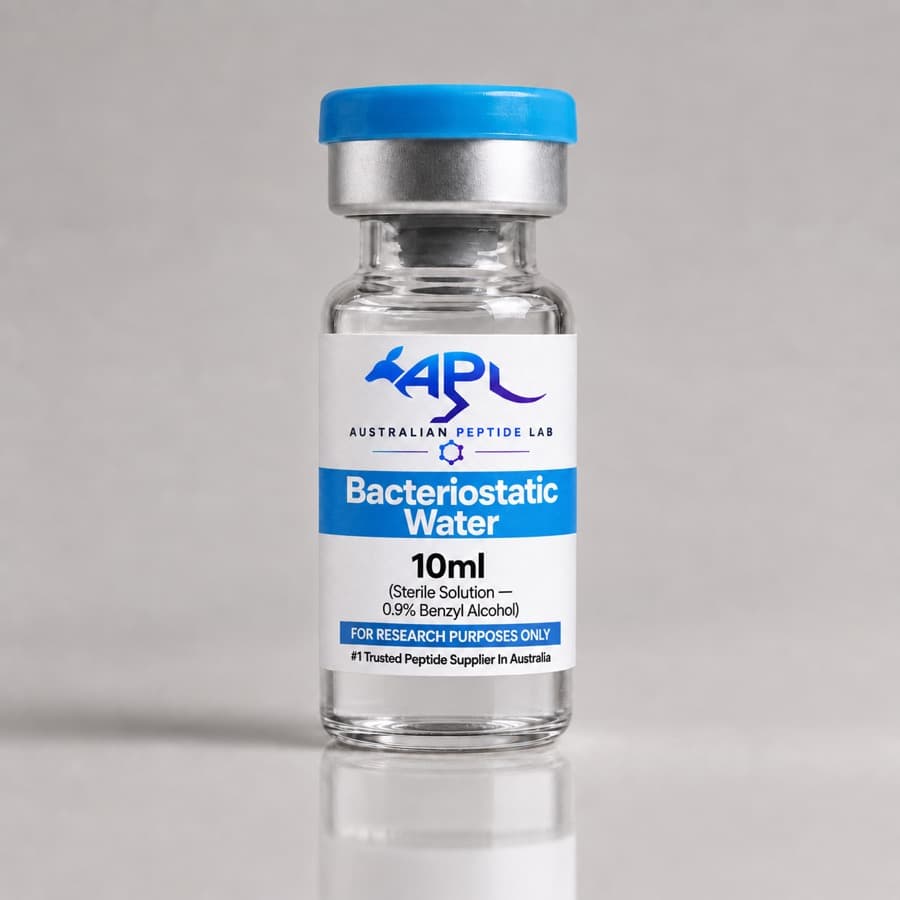
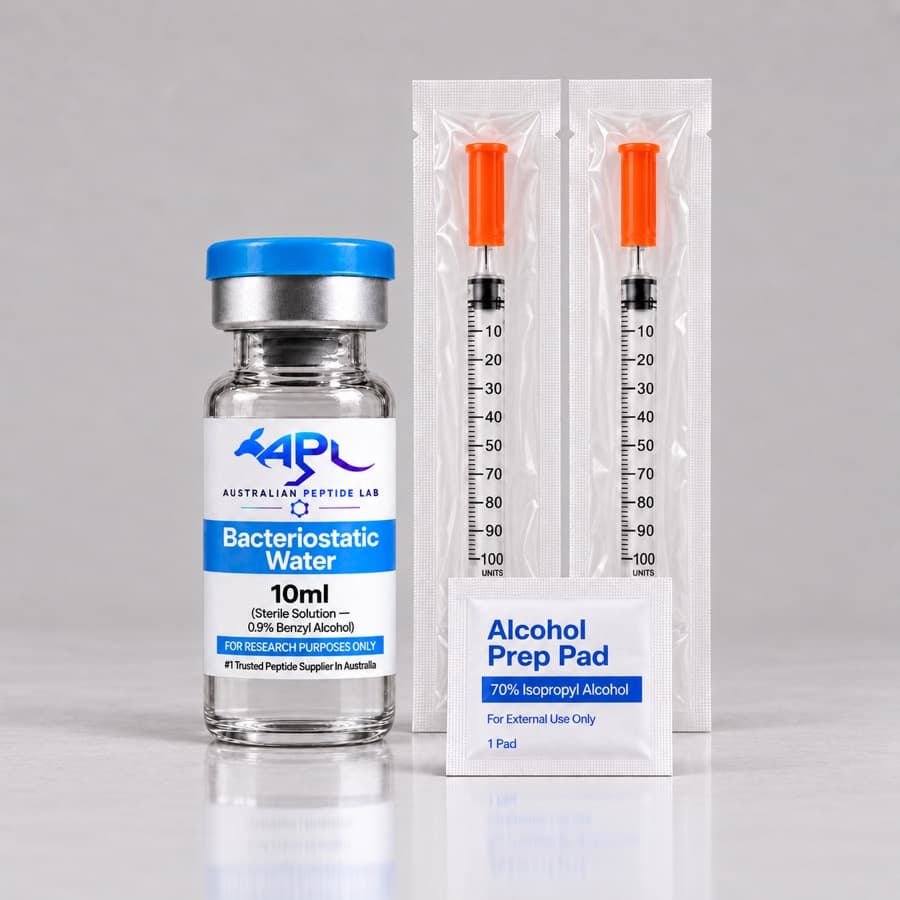
Both diluents are reconstitution tools rather than reagents in their own right; the peptide reconstitution guide covers how either goes into a vial. Our bacteriostatic water is supplied in 10 mL vials and as part of the Research Starter Kit.
Frequently asked questions
Which diluent is better for peptide stocks used in cell culture?
Sterile water, in most cases. It adds nothing to the vehicle, and stocks for cell work are usually aliquoted and frozen, where a preservative has no role. Benzyl alcohol is membrane-active: it inhibited endocytosis [4] and altered cAMP signalling [3] in cultured epithelial cells at millimolar concentrations. If bacteriostatic water is used, a matched vehicle control is essential.
How much benzyl alcohol ends up in an assay well?
Divide 83 mM, the benzyl alcohol concentration of bacteriostatic water, by the total dilution factor from stock to well. A 1:100 dilution leaves about 0.83 mM (0.09 mg/mL); 1:1,000 leaves about 83 µM. The dilution calculator gives the factor, and the arithmetic is the same as for any co-solvent [9].
Is a vehicle control enough if bacteriostatic water was used?
A vehicle control at the same benzyl alcohol concentration as every treated well corrects for direct effects of the preservative, and an untreated control alongside it shows whether the vehicle itself shifts the baseline [9, 10]. It cannot correct for an interaction between benzyl alcohol and the peptide, such as preservative-induced aggregation [6]; that needs an analytical check of the stock.
Is sterile water free of endotoxin?
Not necessarily. Sterility means no viable organisms; endotoxin is cell-wall material that survives sterilisation and is a separate specification. Commercial-grade reagents, including synthetic peptide preparations, have been found to carry enough lipopolysaccharide to activate immune cells [12]. For immune-cell assays, choose water and reagents with a stated endotoxin specification; see endotoxin.
Once sterile water is opened, can the rest be kept?
Sterile water has no preservative, so a container that has been entered is no longer assured sterile. Use what is needed in one session and discard the remainder, or divide it into sterile single-use portions immediately in a clean cabinet. Bacteriostatic water exists for the opposite case, a vial entered repeatedly; see what is bacteriostatic water.
References
- 1.Chang YS, Wu CL, Tseng SH, et al. In vitro benzyl alcohol cytotoxicity: implications for intravitreal use of triamcinolone acetonide. Exp Eye Res. 2008. PubMed 18420195
- 2.Chang YS, Lin CF, Wu CL, et al. Mechanisms underlying benzyl alcohol cytotoxicity (triamcinolone acetonide preservative) in human retinal pigment epithelial cells. Invest Ophthalmol Vis Sci. 2011. PubMed 21345998
- 3.Friedlander G, Le Grimellec C, Giocondi MC, et al. Benzyl alcohol increases membrane fluidity and modulates cyclic AMP synthesis in intact renal epithelial cells. Biochim Biophys Acta. 1987. PubMed 2820491
- 4.Giocondi MC, Mamdouh Z, Le Grimellec C. Benzyl alcohol differently affects fluid phase endocytosis and exocytosis in renal epithelial cells. Biochim Biophys Acta. 1995. PubMed 7696294
- 5.Simm R, Kvalvaag AS, van Deurs B, et al. Benzyl alcohol induces a reversible fragmentation of the Golgi apparatus and inhibits membrane trafficking between endosomes and the trans-Golgi network. Exp Cell Res. 2017. PubMed 28450044
- 6.Bis RL, Singh SM, Cabello-Villegas J, et al. Role of benzyl alcohol in the unfolding and aggregation of interferon α-2a. J Pharm Sci. 2015. PubMed 25100180
- 7.Li M, Falk BT, Lu X, et al. Molecular Mechanism of Antimicrobial Excipient-Induced Aggregation in Parenteral Formulations of Peptide Therapeutics. Mol Pharm. 2022. PubMed 35917158
- 8.You T, Yuan S, Bai L, et al. Benzyl alcohol accelerates recovery from Achilles tendon injury, potentially via TGF-β1/Smad2/3 pathway. Injury. 2020. PubMed 32409188
- 9.Galvao J, Davis B, Tilley M, et al. Unexpected low-dose toxicity of the universal solvent DMSO. FASEB J. 2014. PubMed 24327606
- 10.Nguyen TV, Alfarsi A, Nguyen HT, et al. Metabolic disruptions induced by low concentrations of DMSO in RTgill-W1 fish cells: The importance of solvent controls in in vitro studies. Aquat Toxicol. 2025. PubMed 40209297
- 11.Highsmith AK, Greenhood GP, Allen JR. Growth of nosocomial pathogens in multiple-dose parenteral medication vials. J Clin Microbiol. 1982. PubMed 7050144
- 12.Weinstein JR, Swarts S, Bishop C, et al. Lipopolysaccharide is a frequent and significant contaminant in microglia-activating factors. Glia. 2008. PubMed 17910052
This article summarises published research for educational purposes. It is not medical advice. Compounds sold by Australian Peptide Lab are research reagents for in-vitro laboratory use only, not for human or veterinary use.