
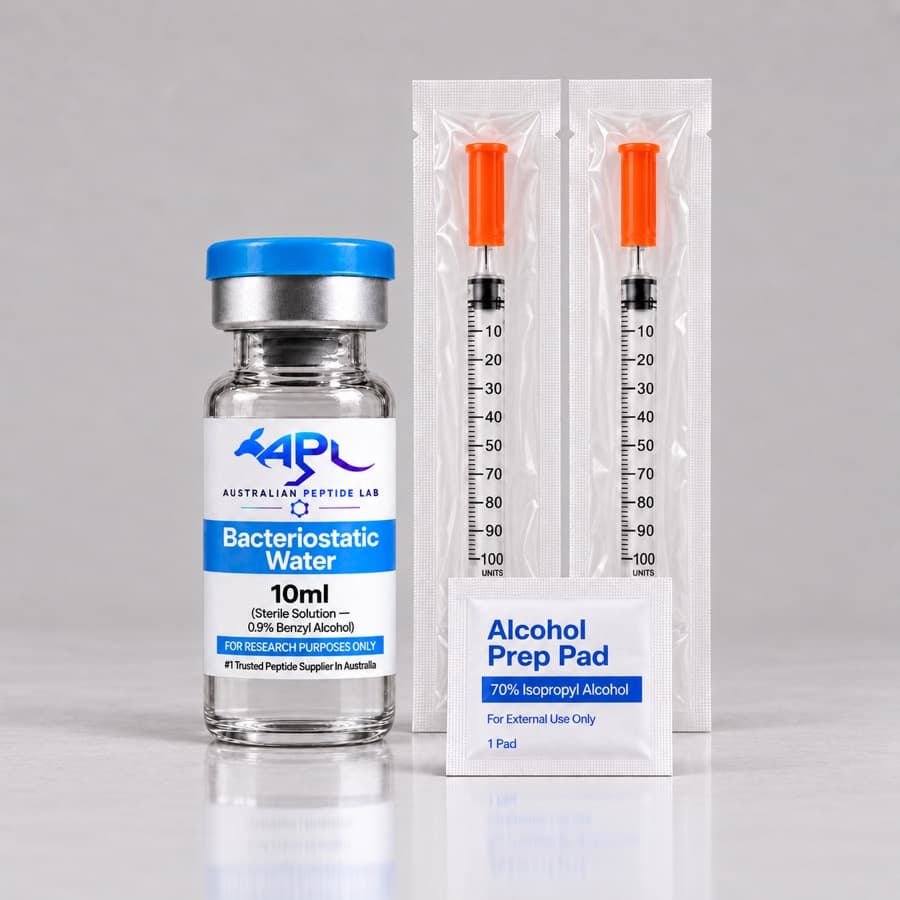
Research Starter Kit
The Research Starter Kit holds the consumables for reconstituting lyophilised peptides: a 10 mL vial of bacteriostatic water, ten sterile 1 mL insulin syringes with fixed 29G needles and twenty alcohol prep swabs. It contains no peptide. Each component covers one step of the bench workflow: disinfecting a septum, measuring diluent, transferring it into the peptide vial and withdrawing measured volumes of stock.
Total
$24.00 AUD
Out of stock — fresh batches are being tested now.
- 🚚 Order before 12pm AEST for same-day dispatch · express 1–3 business days
- 📦 Free shipping over $250 (otherwise $14.95) · plain, unbranded packaging
- 🛡️ 14-day replacement or refund if damaged, defective or incorrect
All products sold by Australian Peptide Lab are strictly for in-vitro laboratory research purposes only. Not for human or veterinary use, consumption, or any form of in-vivo application.
What is in the kit
The kit supplies the consumables for one stage of peptide work, turning a lyophilised cake into a measured stock solution. It contains no peptide; it is designed to sit beside vials from the shop, and the same components come with retatrutide and GHK-Cu in the Complete Research Bundle.
| Component | Quantity | Role in reconstitution |
|---|---|---|
| Bacteriostatic water, 0.9% benzyl alcohol | 1 × 10 mL vial | Diluent for lyophilised peptide; preserved for repeated withdrawals within 28 days of first puncture |
| Sterile 1 mL insulin syringes, fixed 29G needle | 10 | Measuring diluent, transferring it through the vial septa, and withdrawing measured volumes of stock for dilution |
| Alcohol prep swabs | 20 | Disinfecting each rubber septum before it is punctured |
Ten syringes and twenty swabs give ten complete transfers, each through two swabbed septa. At 2.0 mL of diluent per peptide vial, the 10 mL of bacteriostatic water covers five reconstitutions, so for most uses the syringes run out before the diluent does.
How the components fit the workflow
- Equilibrate. Let a lyophilised vial from the freezer reach room temperature before the seal is pierced, so condensation does not wet the powder.
- Disinfect. Swab the diluent vial's septum and the peptide vial's septum, and let the alcohol dry.
- Measure. With a fresh syringe, withdraw the planned volume of diluent; the reconstitution calculator gives the volume in µL for a target concentration.
- Transfer. Add the diluent slowly down the inside wall of the peptide vial rather than directly onto the cake, then swirl gently until clear instead of shaking.
- Label. Record compound, concentration, diluent, date and lot.
- Store. Keep the solution at 2–8 °C, or split it into single-use aliquots and freeze them; the peptide storage guide covers which suits which compound.
The peptide reconstitution guide expands each step, and sterile technique for peptide handling covers bench set-up.
Measuring volumes with a 1 mL syringe
Syringes are less accurate than their markings suggest when only a small fraction of the barrel is used. In a study in which three investigators measured 5–20% of the capacity of 1, 3, 5, 10 and 20 mL syringes, mean errors ranged from 1.4% to 18.6% despite a manufacturer specification of ±5%, and errors above 5% became more likely once less than 20% of the labelled capacity was measured [1]. The authors recommended measuring at least 20% of capacity and choosing a syringe close to the target volume [1].
| Target volume | With a 1 mL syringe | Comment |
|---|---|---|
| 2.0 mL of diluent | Two full fills | Each fill adds its own reading error |
| 1.0 mL of diluent | One full fill | Best use of the barrel |
| 250 µL of stock | One partial fill | Above the 20%-of-capacity guide [1] |
| 50 µL of stock | Not advisable | Below 20% of capacity; use a calibrated micropipette or dilute first |
Read the barrel in millilitres and convert to µL for the calculators. For volumes below about 200 µL, a serial dilution worked out with the dilution calculator is more reproducible than a very small draw.
Needle gauge, coring and septum wear
Each puncture of a rubber stopper can cut a fragment, or core, from it, and bore size is the main driver. Puncturing propofol vial stoppers with 18G, 20G and 21G needles produced cores in 17% of samples overall, most of them with the 18G needle, regardless of puncture angle [2]. In radiopharmaceutical vials, stoppers kept their self-sealing capacity for a median of more than 100 punctures with 22G and 20G needles; cores were frequent after many 18G punctures and rare with 22G [3].
A 29G needle is finer than any gauge in those studies, so the trend points to little coring, at the cost of slower draws. Drawing steadily rather than forcing the plunger, and inspecting stock solutions for particles against a dark background, covers the remaining risk.
Swabbing technique
How the swab is used matters as much as using one. In a comparison of three methods on 90 deliberately contaminated vial stoppers, three back-and-forth wipes, or three one-directional wipes each with a fresh face of the swab, reduced bacterial counts significantly; three one-directional wipes with the same face did not differ from no disinfection [4]. Let the alcohol evaporate before puncturing, so it is not carried into the vial.
Choosing the diluent for the experiment
The included bacteriostatic water suits stocks that will be sampled several times. Its benzyl alcohol is not inert in cell systems: in human retinal pigment epithelial cells, 0.225 mg/mL impaired function within 2 hours while 0.0225 mg/mL did not [5]. A stock made in bacteriostatic water and diluted 1:100 into medium still carries 0.09 mg/mL, so cell-based work needs a vehicle control with matched benzyl alcohol, or a stock made in sterile water. Bacteriostatic water vs sterile water compares the two in detail.
What the kit does not include
The kit covers reconstitution, not the rest of the bench. Depending on the experiment, also plan for:
- preservative-free sterile water for cell-assay stocks;
- calibrated micropipettes and low-binding tubes for aliquots and volumes under 200 µL;
- a sharps container for used needles;
- freezer-safe labels and storage boxes for aliquots.
Storage
Store the kit at room temperature. Once the bacteriostatic water is first punctured, date it and discard it after 28 days. Use each syringe once. Lyophilised peptides belong at −20 °C until reconstitution; how lyophilisation works explains how the dry cake is made.
Research Starter Kit: frequently asked questions
Does the Research Starter Kit include a peptide?
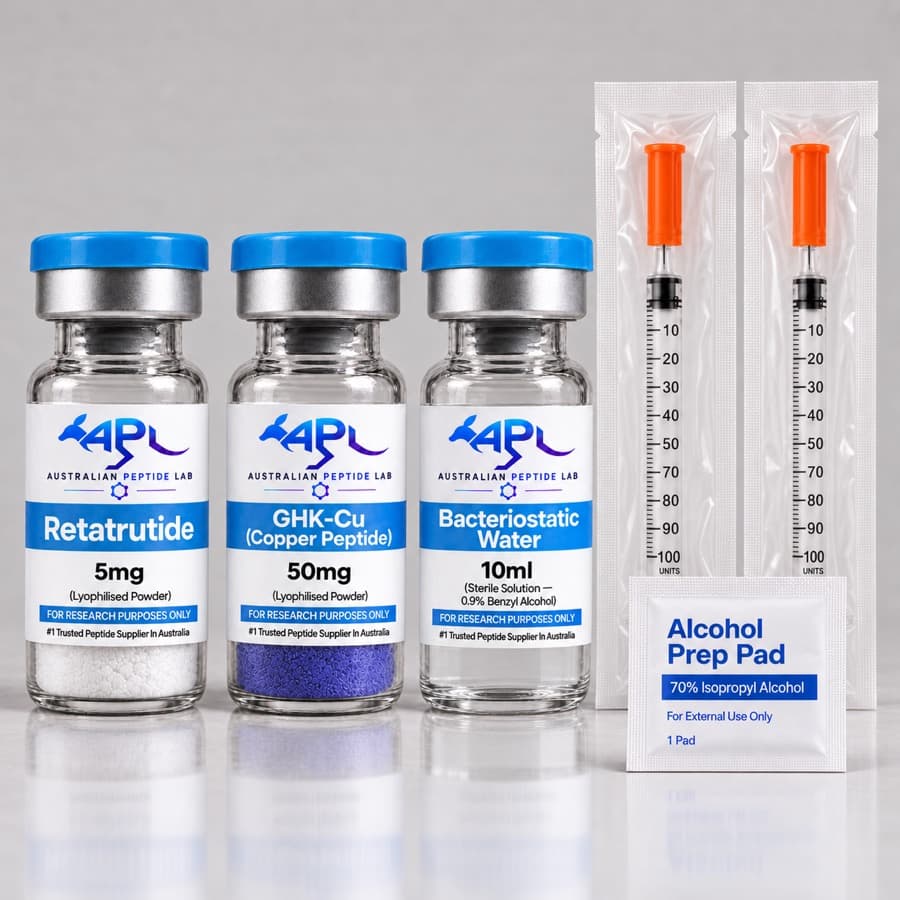
No. It contains only the diluent, syringes and swabs. The Complete Research Bundle pairs the same consumables with a 5 mg retatrutide vial and a 50 mg GHK-Cu vial, and every other compound is listed in the shop.
Why are there twenty swabs but only ten syringes?
Each transfer passes a needle through two septa, the diluent vial's and the peptide vial's, and each septum is swabbed before it is punctured. Twenty swabs therefore match ten transfers. Technique matters: three one-directional wipes with the same face of a swab did no better than no disinfection in one comparison, whereas back-and-forth wiping or a fresh face for each wipe reduced bacterial counts [4].
How small a volume can a 1 mL syringe measure reliably?
In a gravimetric study of syringes from 1 to 20 mL, errors above 5% became more likely once less than 20% of the labelled capacity was measured, so the authors recommended measuring at least 20% of capacity [1]. For a 1 mL syringe that is about 200 µL. Smaller volumes are better handled with a calibrated micropipette or by diluting first.
Is the included bacteriostatic water suitable for cell-culture stocks?
Only with a matched vehicle control. Its 0.9% benzyl alcohol is carried into the working solution, and benzyl alcohol impaired human retinal pigment epithelial cells within 2 hours at 0.225 mg/mL [5], a level reached by a 1:40 dilution of the diluent. Many labs reconstitute cell-assay stocks in sterile water instead; the bacteriostatic water monograph sets out the data.
Can the syringes be used more than once?
Treat each as single-use. Reusing a needle or syringe is one of the handling shortcuts that infection-control reviews link to contaminated multiple-dose vials [6], and in a 28-day in-use study, vials stayed free of bacteria and endotoxin when a new needle was used for every puncture [7]. Ten syringes cover ten separate transfers.
How long does the bacteriostatic water last once opened?
Discard it 28 days after first puncture, the default in-use period for opened multiple-dose vials, or earlier if it turns cloudy. Write the date on the label when the seal is first pierced: in one hospital survey only half of opened vials were dated, and 13% of the dated ones were already past their discard date [8].
References
- 1.Jordan MA, Choksi D, Lombard K, et al. Development of Guidelines for Accurate Measurement of Small Volume Parenteral Products Using Syringes. Hosp Pharm. 2021. PubMed 34024924
- 2.Chotikawanich T, Kammee T, Khantee S. The impact of needle size and angle on rubber coring after multiple puncturing of multi-dose propofol vial rubber stoppers. Heliyon. 2022. PubMed 35592659
- 3.Ponto JA. Self-sealing capacity of vial stoppers after multiple needle punctures. J Am Pharm Assoc (2003). 2013. PubMed 23636157
- 4.Bjornstad M, Kosinski T, Burlage R. Evaluation of the Efficacy and Superiority of Different Vial Rubber Closure Disinfection Techniques. Int J Pharm Compd. 2020. PubMed 32886643
- 5.Chang YS, Wu CL, Tseng SH, et al. In vitro benzyl alcohol cytotoxicity: implications for intravitreal use of triamcinolone acetonide. Exp Eye Res. 2008. PubMed 18420195
- 6.Wick JY, Zanni GR. Proper use of multidose vials. Consult Pharm. 2006. PubMed 17243851
- 7.Simonek GD, Alarcio GG, Brignolo LL. Sterility and Stability of Diluted Carprofen in a Multidose Vial in the Laboratory Animal Setting. J Am Assoc Lab Anim Sci. 2017. PubMed 28535864
- 8.Mattner F, Gastmeier P. Bacterial contamination of multiple-dose vials: a prevalence study. Am J Infect Control. 2004. PubMed 14755229
Related Research Compounds
 Out of stock
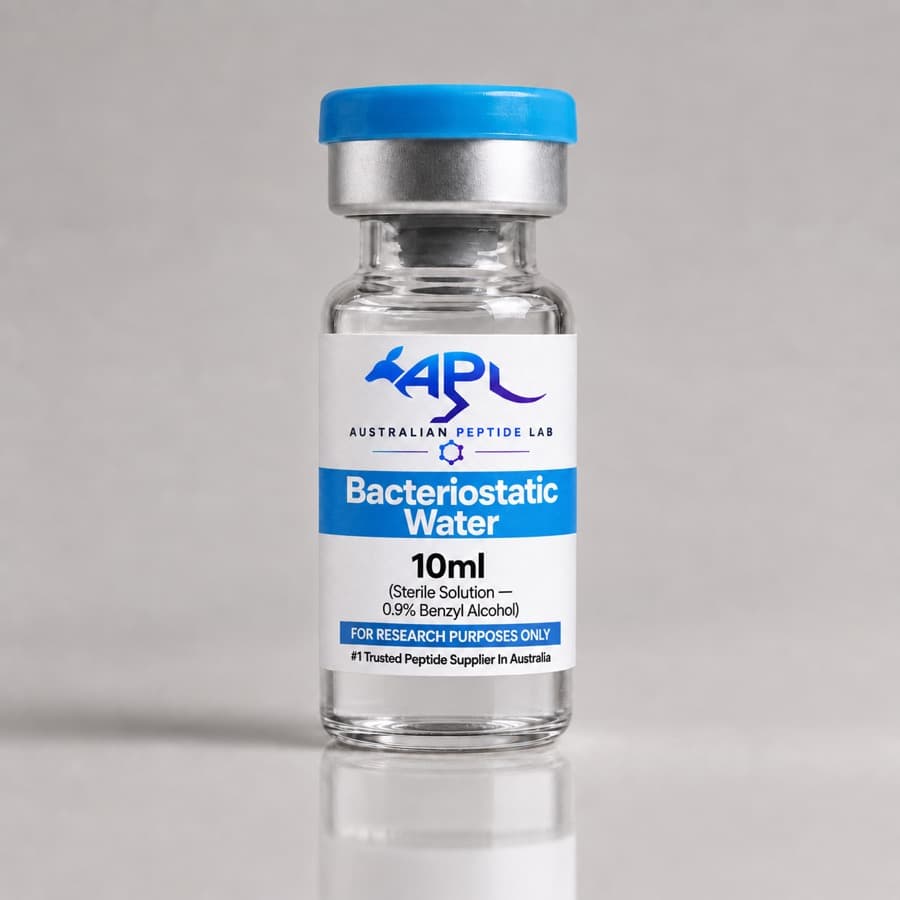
Bacteriostatic Water
USP grade, 0.9% benzyl alcohol
 Out of stock
Brand Starter Kit — 50 Vials
≥99% (HPLC verified, batch COAs for every compound)
 Out of stock
Complete Research Bundle
≥99% (HPLC verified peptides)
Read more about Research Starter Kit
Peptide Reconstitution: A Bench Method for Lyophilised Research Peptides
A bench method for reconstituting lyophilised peptides: equilibration, diluent choice, adding diluent, concentration tables, aliquoting and labelling.
8 min read →Lab TechniqueSterile Technique for Peptide Solutions: Aseptic Bench Practice, Filtration and Records
Aseptic technique for peptide solutions: clean benches vs biosafety cabinets, routine, sterile filtration losses, endotoxin, equipment and records.
6 min read →Lab TechniqueWhat Is Bacteriostatic Water? Composition, Benzyl Alcohol and Laboratory Use
Bacteriostatic water explained: 0.9% benzyl alcohol chemistry, how the preservative works, its limits, in-use handling and how it interacts with peptides.
6 min read →